 STOIKOFF
wip
renounce the behavior
The observer influences the events observed simply by being there to observe them.
We typically understand observation as a synonym for vision. Firstly, I suggest distinguishing observation as a deliberate and intentional operation separate from the sensory activity naturally given by merely having one’s eyes open. It’s crucial to clarify that while the observation of a subject is presumed to be a passive action for the one being observed, it can also manifest actively in the role of the “observed,” in addition to the “observer.” Similarly, the observing subject is expected to be in a position of exercising power. However, the observed subject can be either a voluntary or involuntary subordinate.
Having separated the above concepts, it is possible to dissociate from the observational practice two radically different possibilities: surveillance as a control mechanism directly linked to (dis)obedience and punishment, allowing monitoring, sometimes persecution, to maintain established order; and voyeurism, the perverse pursuit of sexual pleasure through contemplative enjoyment. On the other hand, the observed subject may or may not be aware of this situation, but this is not determinative of their position in relation to the observer; rather, it is the action they take towards the other, such as exhibitionism or inhibition and self-censorship.
The purpose of the work is to challenge the participant regarding observation as a dialectical phenomenon between the observing subject and the subject being observed, all mediated by subjectivity. The work consists of a video installation in a space with two interconnected rooms communicated by an elevator:
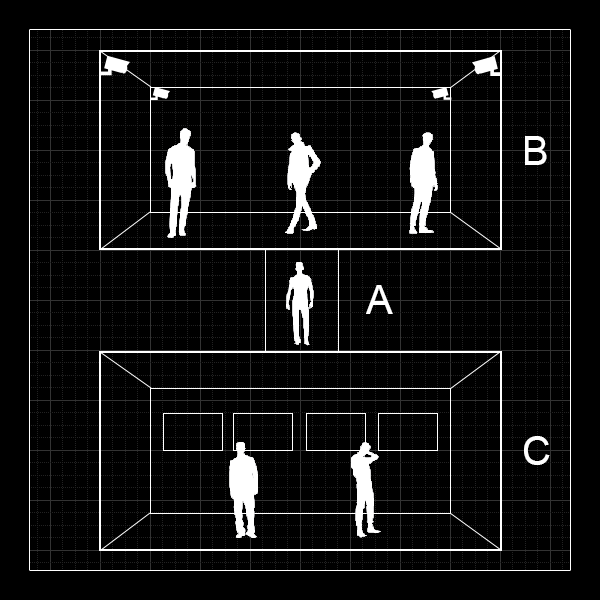
It is accessed through an elevator (A), connecting rooms B and C. This elevator is covered in mirrors, alluding to the participants’ subjectivity, constituting the ego in the Lacanian mirror stage. Located on the surface, it is the first place upon entering the installation corpus, reflecting our own gaze back to us.
Ascending is room B, a larger space than A but no less claustrophobic, intensely illuminated. Cameras pointing where the public moves represent the omnipresent eyes of Argos Panoptes and, in turn, those in room C. Individuals in room B are the observed, subjected to the experience of surveillance. This installation suggests the moral instance of the superego, inhibition, repression due to norms, and violation of these norms. It is the highest point of the journey, as surveillance positions are always from top to bottom, always above us, like the all-seeing eye.
Below ground level is room C, equal in size to room B but oppositely dark. It is the place of surveillance, the realm of primitive instincts, life and death drives operating under the pleasure principle, in this case, voyeuristic pleasure or the simple exercise of power. Participants find on the screens in room C what the cameras in room B record, inviting reflection on the act of power that confers control over others. It is located underground because, though we know of its existence, this place is hidden, covered, and precisely from that deep place, it operates on us.
The journey through the three rooms of the work demands reflection on the surveillance mechanisms we constantly and routinely encounter to the point of naturalizing them. Thus, the full realization of the work is expected through the participant’s action, reaching completeness at that moment.
Requirements
Location
The work requires a space with at least three levels:
- Elevator access on the ground floor.
- First floor (or higher) with a space of at least 3 × 3 m.
- Basement similar to the first floor.
The three levels must be connected by an elevator and should be directly accessible from its door, without intervening hallways or other spaces.
The location must have wireless (WiFi) or wired internet connection with the possibility of installing a wireless access point, both in room A and room B.
Equipment
| Element | Quantity | Observations |
|---|---|---|
| Self-adhesive vinyls | With the symbols 0, ▲ and ▼ | |
| 650 W Fresnels | 4 | |
| Security cameras | 4 | |
| Camera housing | 4 | |
| 24” LCD screens | 4 | |
| VGA cables | 4 | |
| 4-channel DVR | 2 | |
| WiFi router | 1 | |
| Patchcord | 1 | |
| Power strip and extensions | Varies | |
| Desktop PC | 1 | |
| Video card | 2 | Requires 4 video outputs |
| WiFi connection card | 1 | |
| Wooden board (2 × 0.7 m) | 2 | White |
| Easels | 3 | |
| Gazebos with walls (3 × 3 m) | 2 | One white and one black |
Setup
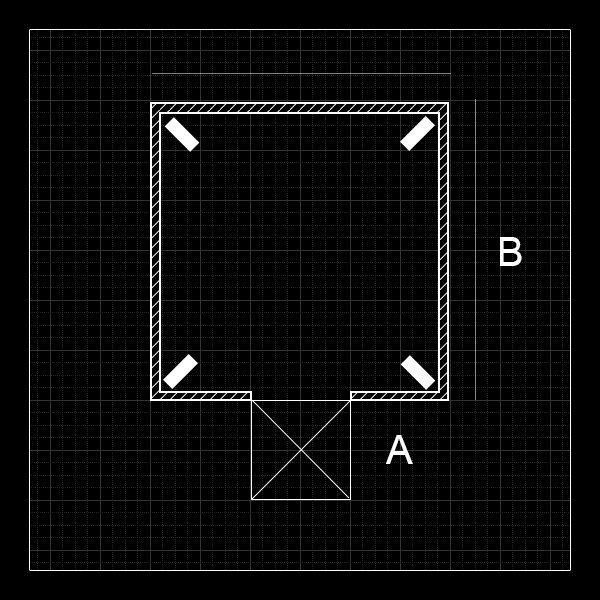
Four analog surveillance cameras will be mounted in their respective cabinets on the four corners of room B, pointing towards the center, according to the diagram below. Each camera will be connected to a Digital Video Recorder (DVR) that captures the video signal from the cameras. Through software, it will be possible to control and capture the video remotely. For this, the DVR, via an ethernet connection to a router with internet access, will publish the camera images in real-time. Wiring and signal digitization/transmission equipment will be installed behind the walls. Regarding lighting, four 650 W LED Fresnels will be installed in each corner, creating a saturated lighting environment.
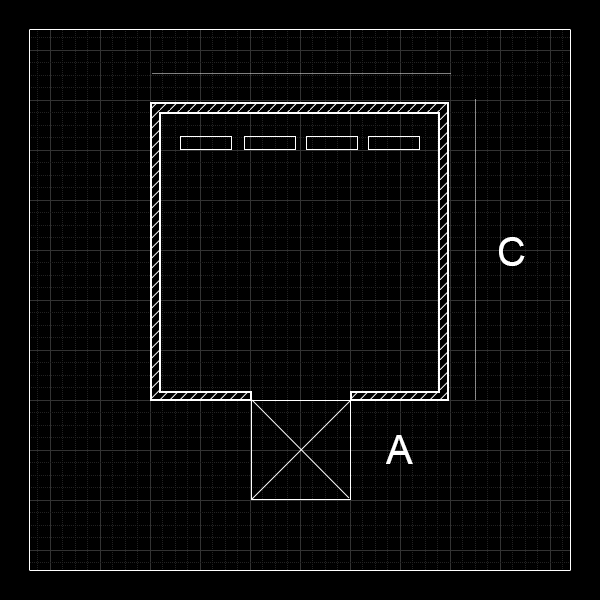
In room C, a table will be assembled using a 2-meter-long by 0.7-meter-deep wooden board placed on three easels. Another similar board will be used to create a front cover to conceal the wiring. Under the table, the PC will be positioned, connecting to the DVR via wireless network (WiFi) and, through VGA cables, transmitting the image from the cameras in room B to the four 24-inch LCD monitors installed on the table. There will be no additional lighting other than the monitors, configured with the lowest brightness possible to maintain a dark atmosphere and compel participants to approach for a clear view of the image.
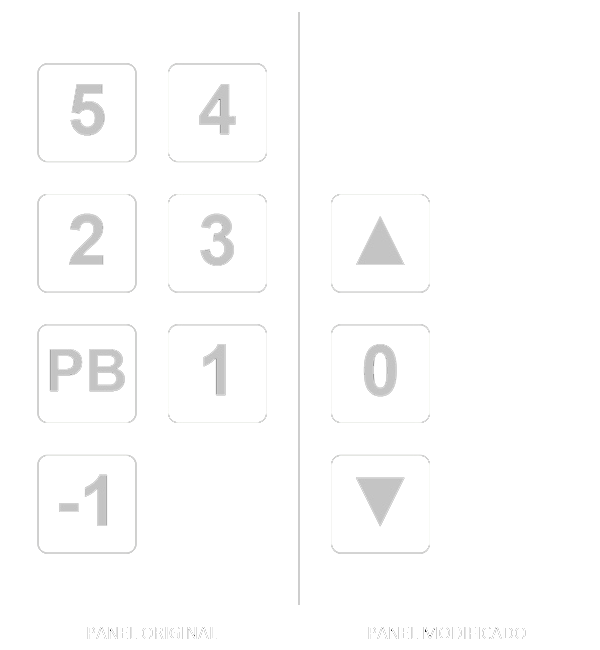
The elevator will have the control panel modified with a self-adhesive vinyl according to the scheme below. The only accessible buttons will be those identified with the symbols 0, ▲ and ▼.